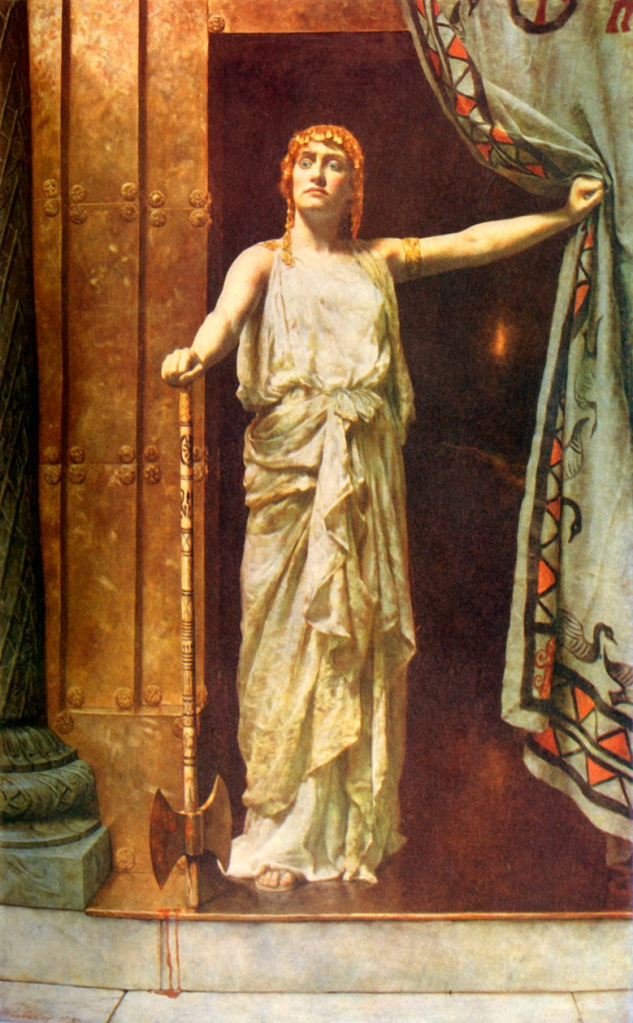
Queen, mother, murderer, murdered. Forgotten. misunderstood. Sought vengeance for filicide and paid with the only currency she had left, her life.
My research focuses on information about Clytemnestra’s portrayals across different time periods and I, then, analyse what these interpretations reveal about politics, education, and society.Based on my research, I aim to provide a comprehensive analysis of Clytemnestra’s evolving portrayals and what they reveal about politics, education, and society across different eras.
Clytemnestra’s Evolving Portrayals Through History
Ancient Greek Literature
The earliest portrayals of Clytemnestra show significant variations that already reflect the political tensions of their times:
Homer’s Odyssey: Her role in Agamemnon’s death is unclear and her character is less defined, suggesting early versions were more ambiguous about female agency and culpability.
Aeschylus’s Oresteia (5th century BCE): She murders Agamemnon and the Trojan princess Cassandra, whom Agamemnon had taken as a war prize following the sack of Troy. Aeschylus reflects the perception of women in patriarchal democratic Ancient Greek society by Clytemnestra who is a “non-ideal” image of woman. She exposes the imposed “ideal women” identity on females by the male dominant Athenian sociological system by rejecting it.
Euripides and Sophocles: Euripides portrays Clytemnestra as a woman tormented by her past deeds, seeking justification for her actions. Sophocles, the third of the great Athenian tragedians, also tackled the story of Clytemnestra and Electra. In his rendition, Clytemnestra’s character is more assertive, defending her actions with greater complexity.
Modern Feminist Reinterpretations
Contemporary literature has dramatically reframed Clytemnestra’s story:
Contemporary Feminist Lens: Taken from the perspective of the patriarchy, Clytemnestra did something evil and unforgivable. From a modern perspective, she had immense restraint and courage. When we talk about needing more strong female characters in literature, this is what we mean.
Recent Literary Works: “Clytemnestra” by Costanza Casati is arguably a perfect reimagining of one of Greek mythology’s most notorious figures. This novel reinterprets the life of Clytemnestra, often vilified as a murderous queen, through a modern, feminist lens.
Political and Social Analysis
What These Portrayals Reveal About Politics of Each Era
Ancient Athens (5th century BCE): The varied ancient portrayals reflect the tensions within Athenian democracy about women’s roles in society. She is one of the few mortal women in Greek mythology portrayed as both a ruler and a political actor. Her power comes from her intelligence, her ability to manipulate those around her, and her capacity to act decisively, even in morally ambiguous situations. This complexity suggests ancient audiences grappled with questions of female authority and justice versus social order.
Modern Era: Modern feminist insights and fresh interpretations challenge old myths, seeking to reframe this tragic tale through a feminist lens and ensure her voice is heard amid the chaos of betrayal and loss. These reinterpretations reflect contemporary concerns about gender equality, victim-blaming, and the need to examine historical narratives through multiple perspectives.
The Enduring Relevance of Classical Literature
The continued fascination with Clytemnestra demonstrates several crucial points about education and critical thinking:
Pattern Recognition: Clytemnestra’s story reveals recurring patterns of how societies treat women who refuse to conform to expected roles. From ancient Athens to today, her character serves as a lens through which we can examine changing attitudes toward female agency, justice, and power.
Critical Thinking Development: The stark differences between ancient condemnation and modern rehabilitation of Clytemnestra’s character teach us to question narratives and consider multiple perspectives. This develops essential critical thinking skills by showing how the same events can be interpreted differently depending on cultural context and values.
Historical Awareness: Understanding how Clytemnestra has been portrayed across millennia helps us recognize how our own biases and cultural assumptions shape our interpretation of events and people. This historical consciousness is crucial for developing nuanced thinking about contemporary issues.
Educational Value: The evolution of Clytemnestra’s portrayal demonstrates why reading diverse perspectives across time periods is essential. It shows students that literature isn’t just entertainment but a reflection of societal values that can be analyzed, questioned, and reinterpreted.
Building Better Communities Through Classical Education
The study of figures like Clytemnestra contributes to community improvement in several ways:
Courage and Values: Modern reinterpretations encourage readers to examine whether Clytemnestra’s actions, while extreme, reflected courage in the face of betrayal and injustice. This helps develop moral reasoning skills and the courage to question accepted narratives.
Empathy and Understanding: By seeing how differently Clytemnestra has been portrayed across cultures and time periods, readers develop greater empathy for marginalized voices and a deeper understanding of how power structures influence storytelling.
Curiosity and Inquiry: The dramatic shift from viewing Clytemnestra as a villain to seeing her as a complex figure fighting against oppression encourages intellectual curiosity about other “villains” in history who might deserve reexamination.
The enduring power of Clytemnestra’s story lies in its ability to make us question fundamental assumptions about justice, gender, power, and narrative authority.
In my opinion, by studying how different eras have interpreted her character, we develop the critical thinking skills necessary to examine our own times with equal scrutiny and work toward more just and inclusive communities.

Leave a comment